
From Failure to 155 MPH: How Wind Testing Drove a Better Design
Engineering isn't about getting it right the first time, it's about learning from what breaks and building something stronger.
Oasis Engineering
3/9/20262 min read
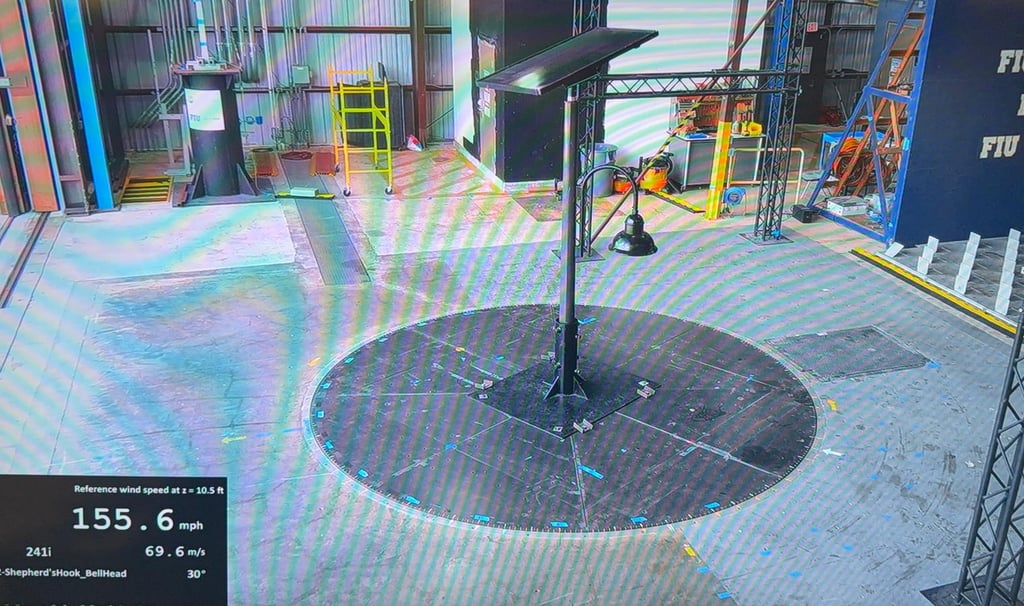
Engineering isn't about getting it right the first time, it's about learning from what breaks and building something stronger. That's exactly what happened during a recent wind testing project at Florida International University's Wall of Wind facility, where an initial failure led to a redesigned system that ultimately survived winds exceeding 155 mph.
It Started with a Failure
During the first round of testing, the original assembly didn't hold up. The solar panel - not the primary support structure, proved to be the weak link, with dynamic wind loading creating stress concentrations at the bolt locations that ultimately led to cracking and fracture around 150–153 mph. That's the entire point of physical testing: code-based analysis tells you what should work on paper, but full-scale hurricane simulation tells you what actually happens.
The failure wasn't a setback. It was data.
Breaking Down What Went Wrong
We pulled the results apart and examined the failure modes carefully. The primary pole structure had performed well, it was the solar panel assembly and its interaction with the mounting hardware that governed system performance. Dynamic upward and downward motion under turbulent loading created localized demands that static or quasi-static analysis methods struggle to capture.
This is where the value of full-scale testing becomes undeniable. ASCE 7-22 gives you the design pressures. FEA gives you stress distribution. But the Wall of Wind gives you real turbulence, real pressure fluctuations, and real aerodynamic interaction between components, things that are difficult, sometimes impossible, to fully capture analytically.
The Redesign: Targeted Reinforcements
Armed with the failure analysis, the design was refined with precision, not over-engineered across the board, but reinforced specifically where the data pointed. Additional framing was introduced to reduce panel movement, distribute load more evenly, and eliminate the stress concentration points that had initiated failure in round one.
Every change was driven by what the first test showed. No guessing.
The Second Test: 155+ MPH and Holding
The reinforced system went back in front of the Wall of Wind. This time, it held. The assembly survived progressively increasing wind speeds well past the original failure point, ultimately remaining intact through winds exceeding 155 mph.
That's not just code-compliant, that's demonstrated performance under conditions that directly simulate a major Florida hurricane.
Why This Matters
If you're an engineer, contractor, or building official evaluating exterior systems for hurricane-prone regions, this process illustrates something important: wind load calculations and physical wind testing are complementary, not redundant. Calculations establish the baseline. Testing validates real-world performance, and sometimes exposes gaps that calculations can't predict.
WindCalculations' engineering assessments are informed by this kind of direct observation. When we evaluate mounting configurations, load paths, and component interactions, we're drawing on more than code equations, we're drawing on what we've actually seen happen at 150+ mph.
WindCalculations.com is operated by Oasis Engineering LLC. All engineering work is performed by licensed Professional Engineers.

WindCalculations.com
+1 (813) 694-8989
info@oasisengineering.com
© 2023 Oasis Engineering LLC. All rights reserved. Doing business as WindCalculations.com