Free tool · ASCE 7-22 §29.4.1 · rooftop equipment
Will the new unit stay on the curb?
Use this when: Replacing an RTU on an existing curb with an adapter, and the reviewer or the owner wants to know whether the fastening is a problem before the submittal.
Lateral on assembly
–lb
ASD, worst face
Uplift on assembly
–lb
ASD
Weight working for you
–lb
–
Fastening demand at your spacing
–
Exhibit A · section
Preliminary · not for constructionWhat the sealed letter adds
The part the reviewer is actually asking for.
- Overturning about the leeward fastener row, both faces, both interfaces
- Per-fastener tension and shear, and the fastener schedule for your screws or lags, ply thicknesses and the curb nailer
- The curb-to-deck load path and the existing curb
- Seismic anchorage where it governs
- Exhibit A detail and a signed, sealed letter addressed to the AHJ
- What is a curb adapter, and why does the wind check matter?
- When a rooftop unit is replaced and the new unit’s footprint does not match the existing curb, a sheet-metal adapter bridges the two. The wind now acts on the unit and the adapter together, and the load has two places to go wrong: the unit-to-adapter screws and the adapter-to-curb screws or lags. Reviewers ask for the check because the adapter is the new, untested piece.
- What does this screening show, and what does it leave out?
- It shows the ASCE 7-22 lateral force and uplift on the assembly at your wind speed and exposure, whether the dead load covers the uplift, and how heavy the fastening demand is at the spacing you plan. It does not size the fasteners: the overturning about the fastener rows, the per-fastener tension and shear, the capacity of your screws or lags in your ply thicknesses and nailer, the curb-to-deck path and seismic anchorage are the engineered letter.
- Which wind speed do I enter?
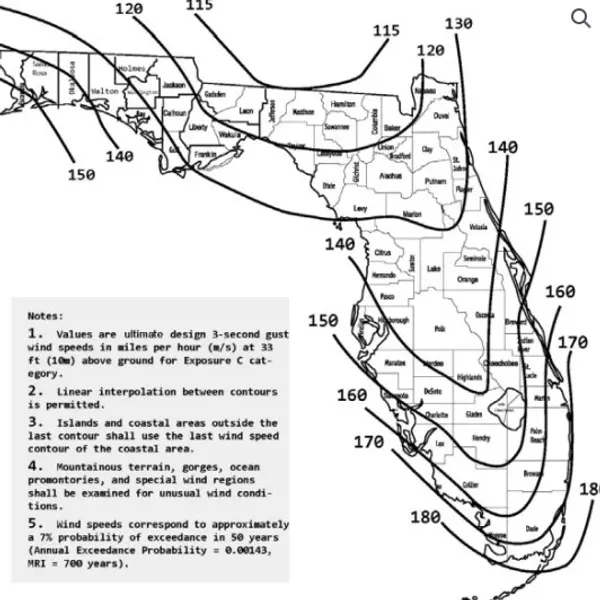
- The ultimate design wind speed for the site and risk category from the ASCE 7-22 map (our free wind speed tool finds it by address). Use the mean roof height of the building, not the height of the unit.
- The band says Heavy. What now?
- Nothing is wrong yet; it means ordinary screw patterns at that spacing are unlikely to work and the connection needs engineering. Send the unit submittal, the adapter drawing and the curb details and we return a sealed letter with the fastener schedule and an installation detail.
About this check. Free, automatic and simplified: ASCE 7-22 Section 29.4.1 forces on rooftop equipment for buildings up to 60 ft, with Kzt = 1, sea-level Ke, Kd = 0.85 (Table 26.6-1), the unit and adapter treated as rigid bodies, and ASD values at 0.6 W and 0.6 D. The demand band is a screening scale, not a fastener design. Nobody has reviewed your project, and nothing here is signed or sealed. It is not a permit document and does not create an engineer-client relationship. Terms of use.
What happens next
Take the number somewhere.
The permit version.
Fixed price for single-family residential. You order, upload the product data, and a PE-sealed PDF comes back in a few business days.
See the packages