Florida · FBC 2023 · Miami-Dade & Broward HVHZ
The wind load certificate your Florida permit asked for.
Doors, windows, roofing, solar and rooftop equipment. Site-specific pressures checked against your NOA or Florida Product Approval, sealed by a Florida PE, in 2–3 business days.
- FBC 8th ed. (2023)
- ASCE 7-22
- HVHZ · Broward & Miami-Dade
- NOA / FL# checked
- Florida PE seal
- 2–3 business days
- 1
Tell us the project
Two minutes online: address, what is being installed, the product approvals. Pay the set price at the end, or get a quote for custom work.
- 2
A licensed engineer runs the site-specific numbers
ASCE 7-22 pressures at your address, height and zone, checked against the NOA or Florida Product Approval.
- 3
Your sealed letter arrives
A PE-signed, sealed PDF for the permit package, usually in 2–3 business days. If the product does not meet the pressure, we tell you first.
Florida packages · single-family residential
Standard packages, scope and price listed upfront.
Each package covers one single-family home (the window package covers all of its windows). Commercial, multifamily or anything unusual: get a quote, usually the same business day.
-
 NEW Florida
Exterior Door Wind Load Certification (HVHZ)
$399 Order → -
 NEW Florida
PV Solar Panel Wind Load Certification (Roof-Mounted)
$499 Order → -
 NEW Florida
Window Wind Load Certification (HVHZ – FBC 2023)
$499 Order → -
 NEW Florida
Roofing Wind Load Letter (HVHZ)
$659 Order → -
 NEW Most jurisdictions
Engineering Wind Load Calculations
$499 Order →
Where you are matters
HVHZ or the rest of Florida.
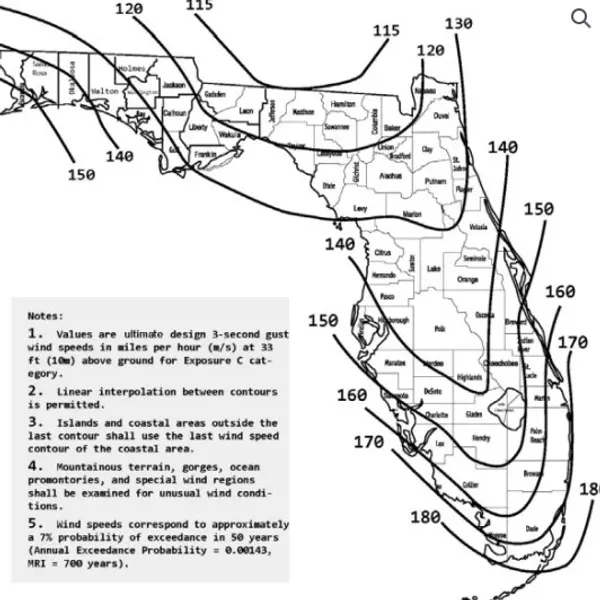
Miami-Dade and Broward (Fort Lauderdale, Hollywood, Pompano, Coral Springs) are the High-Velocity Hurricane Zone. Products need a Miami-Dade NOA, design wind speeds run 170–180 mph, and the letter has to say so in the county's terms. Our HVHZ door, window, roofing and solar letters are written for those reviewers.
Palm Beach north, the Gulf coast, Central Florida and the Panhandle use Florida Product Approvals (FL#) and lower design speeds, but the same question comes up at the permit counter: does this product meet the pressure at this address? The same letter answers it.
Not sure which you are? Enter the ZIP in the free calculator; it flags HVHZ addresses and shows the design pressure.
Questions Florida owners and contractors ask
- What is a Florida engineer wind load certificate?
- A letter, signed and sealed by a Florida-licensed Professional Engineer, that states the design wind pressures at your address (per the Florida Building Code and ASCE 7-22) and confirms that the product you are installing (a door, window, roof covering, solar array or piece of equipment) is approved for at least that pressure. Permit offices ask for it when the product approval alone does not prove the installation works at your site.
- How much does a wind load certificate cost in Florida?
- Fixed prices for single-family homes: from $399 for a door or window certification to $659 for the roofing letter. Commercial, multi-opening and unusual projects are quoted, typically $1,000–$2,100.
- How fast?
- Two to three business days after we have your project details and product approvals. If the permit is waiting, tell us in the request and we will say what rush is possible that day.
- Do you cover Fort Lauderdale and Broward County?
- Yes. Broward and Miami-Dade are the High-Velocity Hurricane Zone, where products need a Miami-Dade NOA and the county reviewers expect the HVHZ wording. Most of our Florida letters are for Broward, Miami-Dade and Palm Beach addresses.
- My product already has an NOA or Florida Product Approval. Why do I need a letter?
- The approval lists the pressure the product resists. The permit office needs the pressure your opening or roof must resist at your address, height and zone, and proof the product rating meets it. The letter is that proof.
- Which code edition applies?
- The Florida Building Code, 8th Edition (2023), which adopts ASCE 7-22 for wind loads. Our letters cite both.
- What do you need from me?
- The property address, what is being installed (sizes and locations, or the roof area), the product approval (NOA or FL#), and plans, a sketch or photos. You upload them in the two-minute request.
Florida articles
- Engineering Rooftop Cooling Tower Replacements in Florida
- Case Study: Fiberglass Light Poles in Florida Hurricanes
- How Hurricane Wind Fields Work — And Why Your Neighbor Got More Damage
- Case Study: HVHZ Window Replacement in Miami
- Rooftop HVAC Installation Wind Analysis: From 150 to 180 MPH
- RTU Curb Installation Engineering with PE Site Visits
- Wind Load Engineering for Sign Panels & Signage Structures
- Solar Panel Support Structures: Cantilevers, Canopies & Rooftop Arrays
- Understanding Roof Wind Load Calculations
- Understanding Your Wind Mitigation Inspection Results
- What Wind Speed Actually Damages a Roof? A Visual Guide
- Two NOAs, one rated roof: specifying Polyglass self-adhered low-slope systems in the High-Velocity Hurricane Zone
- Window Fastening Inspection for Window & Door Permits in Florida | WindCalculations.com
- How Engineers Verify Wind Compliance for Rooftop Solar Panels in Florida
- Wind Load Calculations Are No Longer Just a Florida Thing: Top U.S. Cities Where You Need Them
- Tile Roof Wind Load Certification — Hialeah Gardens, FL
- Front Door Wind Load Certification — Coral Gables, FL
Permit waiting on the wind letter?
Two minutes to send the project. A Florida PE reads every request and the letter is usually back in 2–3 business days.
Request wind calculations